
Introduction
ETFs and CFDs can both provide exposure to financial markets, but they work in fundamentally different ways.
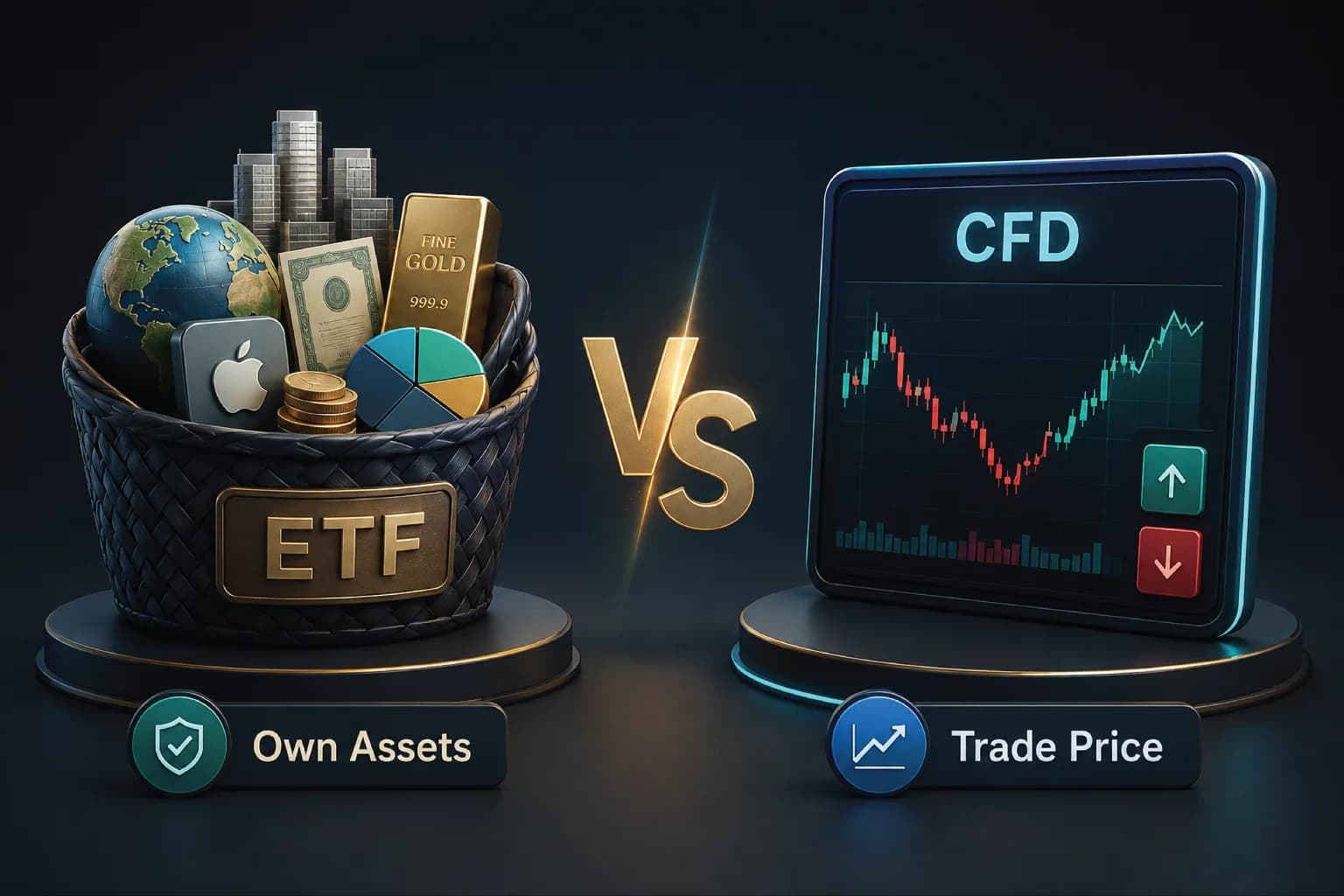
When an investor buys an ETF, they generally purchase shares in the fund. A CFD, or Contract for Difference, is a derivative that provides exposure to price movements without ownership of the underlying asset.
That difference affects ownership, leverage, costs, trading flexibility and risk. Understanding the structure behind each product can help traders better understand what they are trading before opening a position.
This article explains the key differences between ETFs and CFDs, including how CFD exposure to ETFs works and what traders may consider when comparing the two.
ETFs vs CFDs: The Core Difference
An Exchange-Traded Fund (ETF) is an investment fund whose shares are bought and sold on an exchange. ETFs may provide exposure to areas such as equities, bonds, commodities, sectors, indices or specific investment themes.
When investors purchase ETF shares, they generally acquire an ownership interest in the fund rather than directly owning each security within its portfolio.
A Contract for Difference (CFD) works differently. It is a derivative contract linked to the price movement of an underlying market or instrument. Our guide to how CFDs work covers that structure in more detail.
A CFD can reference assets such as:
- currencies;
- shares;
- indices;
- commodities; and
- ETFs.
When a CFD references an ETF, the trader does not purchase shares in the fund. Instead, the CFD reflects movements in the price of that ETF.
The key distinction is ownership versus price exposure.
ETFs vs CFDs: Key Differences at a Glance
| Feature | ETF | CFD |
|---|---|---|
| Structure | Exchange-traded fund share | Derivative contract |
| Ownership | Investor generally owns ETF shares | No ownership of the underlying asset |
| Leverage | Not inherent in a standard cash ETF purchase | Commonly available |
| Margin | Full purchase value is generally required for an unleveraged purchase | A portion of total exposure may be required |
| Short exposure | Depends on product and method | Commonly available |
| Typical costs | Spread, commission and fund expenses may apply | Spread, commission and financing charges may apply |
| Key considerations | Fund structure, concentration, tracking and market risk | Leverage, margin, financing and market risk |
The products may reference similar markets, but their trading mechanics and risk profiles are different.
How Ownership Affects the Product
Ownership is one of the clearest differences between ETFs and CFDs.
With an ETF, the investor generally purchases shares in the fund and gains an ownership interest in that fund.
With a CFD, the trader does not own the underlying asset. Instead, the position reflects changes in the price of the market or instrument referenced by the CFD.
This difference can affect:
- Ownership and voting rights
- Income distributions or adjustments
- Holding costs
- Contractual rights
- How the position is structured
Understanding whether a product involves ownership or derivative exposure is an important part of comparing ETFs and CFDs.
How Leverage Changes CFD Exposure
Leverage is another major difference.
With a standard unleveraged ETF purchase, the investor generally pays the full purchase value of the shares.
A CFD may instead require only part of the total market exposure as margin.
Illustrative Example
Assume a CFD creates USD 10,000 of market exposure.
For illustration only, assume the margin requirement is 10%. The required margin would therefore be USD 1,000.
If the referenced market moves by 2%, the position value changes by:
2% × USD 10,000 = USD 200
A favourable 2% movement may create a USD 200 positive change before applicable costs. An unfavourable 2% movement may result in a USD 200 loss before applicable costs.
Although USD 200 represents 2% of the total market exposure, it represents 20% of the illustrative USD 1,000 margin.
This is why leverage can significantly increase the effect of market movements relative to the amount committed.
The example is hypothetical and does not represent an expected trading outcome.
How ETF and CFD Costs Differ
Cost structures can vary significantly between the two products.
ETF Costs
Depending on the ETF and brokerage arrangement, costs may include:
- Bid-ask spreads
- Brokerage commissions
- Fund expense ratios
- Exchange-related charges
- Applicable taxes
The fund's expense ratio reflects the ongoing costs of operating the ETF and is incorporated into the fund structure.
CFD Costs
Depending on the instrument and account conditions, costs may include:
- Spreads
- Commissions
- Overnight financing charges
- Currency-conversion charges
- Other applicable transaction costs
Financing charges may become more relevant when CFD positions are held overnight. CFD trading costs explained sets out how each of these charges works.
Long and Short Market Exposure
A standard ETF purchase generally provides long exposure to the fund. If its market price rises, the value of the position may increase; if it falls, the value may decline.
Some specialised ETFs, including inverse and leveraged ETFs, use different structures and can involve additional complexity.
CFDs generally allow traders to take either:
- a long position for exposure to rising prices; or
- a short position for exposure to falling prices.
Both directions involve risk. A position can generate losses when the market moves against the trader's chosen direction.
How the Risks Differ
Both ETFs and CFDs involve market risk, but their structures introduce different considerations.
ETF Risks
Depending on the fund, relevant risks may include:
- market risk;
- concentration risk;
- liquidity risk;
- tracking differences;
- currency risk; and
- product-specific risk.
An ETF should not automatically be assumed to provide broad diversification. A sector, thematic or regional ETF may be concentrated in a relatively narrow segment of the market.
CFD Risks
CFD risks may include:
- leverage;
- margin requirements;
- rapid losses;
- volatility;
- market gaps;
- slippage;
- liquidity conditions; and
- financing costs.
Because leveraged CFDs increase market exposure relative to the margin committed, relatively small price movements can have a significant effect on the account. Risk management in CFD trading looks at the controls available for managing that exposure.
ETF or CFD: What Factors Matter?
When comparing ETFs and CFDs, traders may consider factors such as:
- Whether they want ownership or price exposure
- Whether long and short market access is relevant
- The expected holding period
- Applicable trading or fund costs
- Margin requirements, where relevant
- The risks associated with the product and market
The right considerations will vary depending on the trader's objectives, experience and approach to risk.
ETFs & CFDs with Centrino Capital
At Centrino Capital, eligible clients can access both ETFs and CFDs across a range of global markets through MetaTrader 5 (MT5).
Centrino Capital provides access to more than 1,300 instruments through its multi-asset trading environment, with MT5 available across desktop, web and mobile.
Depending on the instrument and applicable trading conditions, clients may have access to:
- Long or short market exposure
- Margin-based trading
- Spreads and applicable commissions
- Overnight financing charges
- Risk-management features
- MT5 trading and charting tools
These features provide flexible access to global markets while allowing clients to review relevant trading conditions, costs and risk considerations.
Conclusion
ETFs and CFDs offer different ways to access financial markets, with distinct structures, costs and risk considerations.
Understanding how each product works can help traders compare their options more clearly and choose the type of market exposure that best matches their objectives, experience and approach to risk.
Frequently Asked Questions
What is the main difference between an ETF and a CFD?
An ETF generally involves purchasing shares in a fund, while a CFD provides exposure to the price movement of an underlying asset without direct ownership.
Are CFDs always leveraged?
CFDs are commonly traded on margin, so leverage is often involved. The level of leverage and margin required depends on the instrument, account conditions and applicable regulatory framework.
Are ETFs always diversified?
Not necessarily. Some ETFs provide broad market exposure, while others focus on specific sectors, themes, regions or asset classes.
What costs should traders compare?
Depending on the product, costs may include spreads, commissions, fund expenses, financing charges and other applicable fees. Traders can review the relevant pricing and product information before trading.
