
Introduction
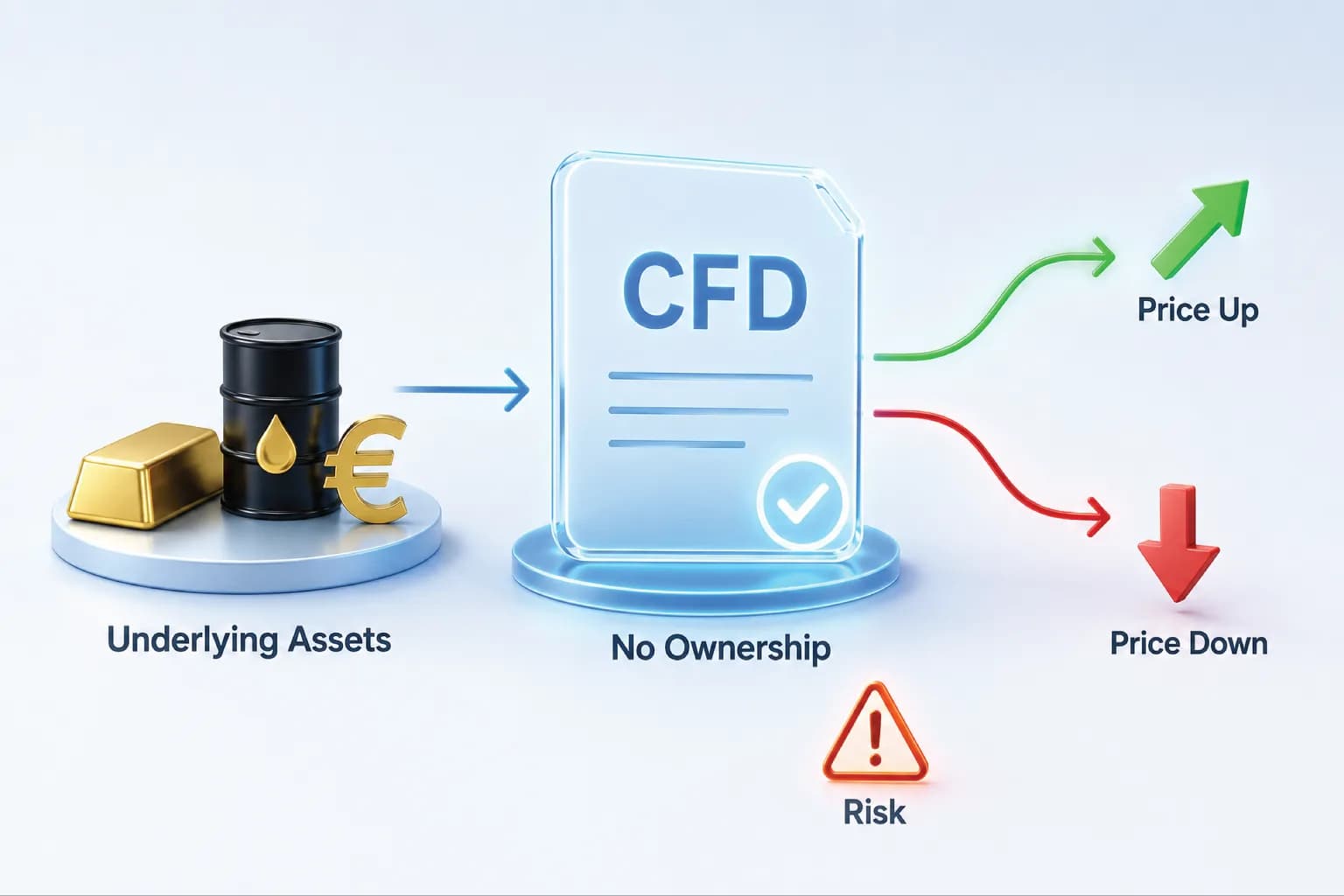
CFD trading allows traders to take positions based on the price movements of financial instruments without directly owning the underlying assets.
Contracts for Difference (CFDs) can provide exposure to different financial markets and allow traders to take positions on both rising and falling prices. They are also commonly leveraged, meaning traders may gain larger market exposure relative to the amount required as margin.
However, leverage increases risk and can magnify losses. Understanding how CFDs work, including position structure, leverage, margin, trading costs and market risks, is therefore important before considering CFD trading.
What Is CFD Trading?
CFD trading involves entering into a contract based on changes in the price of an underlying financial instrument.
Instead of purchasing the underlying asset itself, the trader opens a CFD position. The difference between the opening and closing price contributes to the trading result, together with the position size and applicable costs.
CFDs may provide exposure to markets such as:
- Currencies
- Stocks
- Indices
- Commodities
- ETFs
The instruments available depend on the broker, contracting entity and services permitted within the relevant jurisdiction. Because CFDs are derivatives, their value is linked to an underlying financial instrument or market.
CFD trading also generally does not provide the same ownership rights associated with directly owning an underlying asset. For example, a stock CFD does not normally provide shareholder voting rights because the trader does not own the underlying shares.
How Does CFD Trading Work?
A CFD position is opened based on whether a trader expects the price of an underlying instrument to rise or fall.
The basic process can be understood in six steps:
- Select an available CFD instrument.
- Decide whether to take a long or short position.
- Choose the position size and review the applicable margin requirement.
- Open the position at the available trading price.
- Monitor the position, market movements and account margin.
- Close the position, with the resulting profit or loss reflecting the price movement, position size and applicable costs.
If the market moves in the direction of the position, the trade may generate a profit. If it moves in the opposite direction, the position may generate a loss.
A Simple CFD Trading Example
Consider a simplified hypothetical example in which a CFD is priced at $100.
A trader expects the price to rise and opens a long position equivalent to 10 units.
The total market exposure is:
10 × $100 = $1,000
If the price rises to $105 and the trader closes the position, the difference is $5 per unit:
($105 − $100) × 10 = $50
The gross result would therefore be a $50 profit before applicable trading costs.
If the price instead falls to $95:
($95 − $100) × 10 = −$50
The gross result would be a $50 loss before applicable trading costs.
This example is for educational purposes only and does not include spreads, commissions, financing, currency conversion or other potential charges.
Going Long vs Going Short with CFDs
CFDs allow traders to take positions based on expectations of either rising or falling prices.
Going Long
A trader opens a long position when they expect the price of the underlying instrument to increase.
For example, if a trader opens a long position and the price subsequently rises, the position may generate a profit when closed. A decline in price may instead result in a loss.
Going Short
A short position is based on the expectation that the underlying price will decrease.
If the price falls after the position is opened, the position may generate a profit. If the price rises, the position may generate a loss.
Being able to trade in either direction does not remove market risk. Price movements can be rapid and may differ significantly from expectations.
What Is Leverage in CFD Trading?
Leverage allows traders to obtain market exposure greater than the amount required as initial margin.
As a simplified hypothetical example, consider a CFD position with total exposure of $10,000 and a margin requirement of 10%.
The initial margin would be:
$10,000 × 10% = $1,000
Although $1,000 is required as initial margin in this example, the market exposure remains $10,000.
This means gains and losses are determined in relation to the larger position exposure rather than simply the amount posted as initial margin.
The amount of leverage available can vary according to factors such as the instrument, broker, client classification and regulatory jurisdiction.
What Is Margin in CFD Trading?
Margin is the amount of capital required to open and maintain a leveraged CFD position.
Two concepts are particularly relevant:
Initial Margin
Initial margin is the amount required to open a leveraged position. It is generally calculated as a percentage of the total position exposure.
Margin Requirements
Open CFD positions must meet the applicable margin conditions established for the account and instrument.
When adverse market movements reduce account equity, the account may approach the applicable margin close-out level. Depending on the broker's terms and relevant regulatory requirements, one or more positions may then be automatically reduced or closed.
Margin requirements and close-out rules can differ by broker, instrument, client classification and jurisdiction. Traders should review the conditions applicable to their account rather than assuming the same rules apply across all CFD providers.
What Markets Can Be Traded Through CFDs?
Depending on the broker and jurisdiction, CFDs may provide exposure to several types of financial markets.
Currencies
Currency CFDs are based on movements in exchange rates between currencies.
Stocks
Stock CFDs track movements in the price of individual company shares without requiring the trader to purchase those shares directly.
Indices
Index CFDs provide exposure to movements in an underlying market index rather than an individual company.
Commodities
Commodity CFDs may track markets such as metals, energy products and other commodities.
ETFs
Some CFD providers offer instruments based on exchange-traded funds, allowing traders to take positions on movements in the relevant underlying ETF.
Product availability and specifications can vary, so traders should check which instruments are available through the relevant broker and contracting entity.
Key Features of CFD Trading
Several characteristics distinguish CFDs from direct ownership of financial assets.
Long and Short Market Exposure
- Positions based on expectations of rising or falling market prices
Access to Multiple Markets
- Several asset classes through a single trading platform, depending on the provider
Leveraged Positions
- Margin-based trading, allowing exposure greater than the initial amount required
Trading and Analytical Tools
- Charting
- Technical indicators
- Market analysis
- Position management
Multiple Order Types
- Opening positions
- Closing positions
- Managing positions
These features affect how CFD positions can be managed, but they do not remove the financial risks associated with trading.
What Are the Main Risks of CFD Trading?
CFDs are complex leveraged instruments and involve significant risk. Understanding the main sources of risk is important before considering a position.
Leverage Risk
Because CFD positions can provide market exposure greater than the initial margin, adverse price movements can have a substantial effect on account equity.
Market Volatility
Prices can change quickly following economic announcements, geopolitical developments, company news, changes in market sentiment and other events.
Periods of increased volatility may result in larger or faster-than-expected price movements.
Margin and Position Close-Out Risk
Losses on open positions can reduce available account equity. If the applicable margin requirements are no longer met, positions may be subject to automatic close-out according to the relevant trading conditions and regulatory framework.
Execution and Slippage Risk
An order may sometimes be executed at a different price from the one expected when it was submitted.
This difference, commonly known as slippage, may occur during periods of rapid price movement, market gaps or reduced liquidity.
Liquidity Risk
Liquidity conditions can influence available pricing and order execution. In less liquid or unusually volatile markets, executing a position at the expected price may be more difficult.
Impact of Trading Costs
Trading expenses reduce the net result of a position. Their impact can become more significant with frequent trading or when positions remain open for extended periods.
What Costs Are Involved in CFD Trading?
The cost of trading CFDs can depend on the instrument, account type and broker's pricing structure.
Potential costs may include:
- Spreads: The difference between the bid and ask price.
- Commissions: Transaction-based charges that may apply to certain instruments or account types.
- Overnight financing or swaps: Certain positions held overnight may be subject to financing charges or swap adjustments depending on the instrument, position direction and applicable account conditions.
- Currency conversion: Conversion charges may apply when transactions involve a currency different from the account's base currency.
- Other applicable charges: Additional costs may apply depending on the broker's services and account terms.
Because these expenses can affect the net outcome of a position, traders should review the applicable pricing information before trading.
For a detailed breakdown, see CFD Trading Costs Explained: Spreads, Swaps, Commissions & Fees.
What Should Traders Consider When Choosing a CFD Broker?
A CFD broker should be evaluated across several areas rather than on a single feature such as spreads or the number of available instruments.
Regulation and Compliance
Check which legal entity provides the account, its regulatory status and the jurisdiction under which the services are offered.
Regulatory requirements, restrictions and available client protections can differ between jurisdictions and client classifications. Our guide to why regulation and compliance matter when choosing a CFD broker covers this in more detail.
Trading Costs and Conditions
Review spreads, commissions, financing arrangements and other applicable charges together with execution conditions.
Available Markets
Check whether the broker provides access to the instruments and asset classes relevant to the trader's interests.
Trading Platform and Tools
Consider platform functionality such as charting, analytical tools, available order types and position-management features — see MetaTrader 5 explained for an overview of one widely used platform.
Transparency and Risk Information
Review the broker's product information, risk disclosures, trading conditions and applicable legal documentation.
Client Support
Consider the availability of account and platform assistance, communication channels and relevant support resources.
Evaluating these factors together can provide a clearer understanding of the trading environment and applicable conditions.
CFD Trading with Centrino Capital
Centrino Capital provides access to CFD markets through the MetaTrader 5 trading platform.
Through MT5, traders can access available instruments alongside charting and analytical tools, multiple order types and trade-management functionality.
Before opening a position, traders should review the relevant instrument specifications, applicable trading costs, margin conditions and risk disclosures associated with their account and contracting entity.
Conclusion
CFDs are derivative instruments that allow traders to take positions on movements in financial market prices without directly owning the underlying assets.
Their structure can provide access to different markets, long and short positioning and margin-based trading. At the same time, factors such as leverage, volatility, margin requirements, execution conditions and trading expenses can materially affect outcomes.
Understanding the mechanics and risks of CFDs, as well as the conditions offered by the relevant broker and contracting entity, is an important part of evaluating this type of trading.
Frequently Asked Questions
What does CFD mean in trading?
CFD stands for Contract for Difference. It is a derivative contract based on changes in the price of an underlying financial instrument, allowing traders to gain price exposure without directly owning that asset.
How does CFD trading work?
A trader opens a CFD position based on an expectation that the underlying market price will rise or fall. The trading result depends on the difference between the opening and closing prices, the position size and applicable costs.
What is leverage in CFD trading?
Leverage allows a trader to obtain market exposure greater than the amount required as initial margin. This increases the effect that market movements can have on the trading account.
Can you go long and short with CFDs?
Yes. A long position is based on an expectation that the underlying price will rise, while a short position is based on an expectation that it will fall. Either position can generate a loss when the market moves in the opposite direction.
What should beginners understand before CFD trading?
Before considering CFD trading, beginners should understand how the product works, including position sizing, leverage, margin, trading costs, order execution and the possibility of financial loss. They should also review the conditions, risk disclosures and regulatory framework applicable to the account.
