
Day Trading vs Swing Trading vs Position Trading: What’s the Difference?
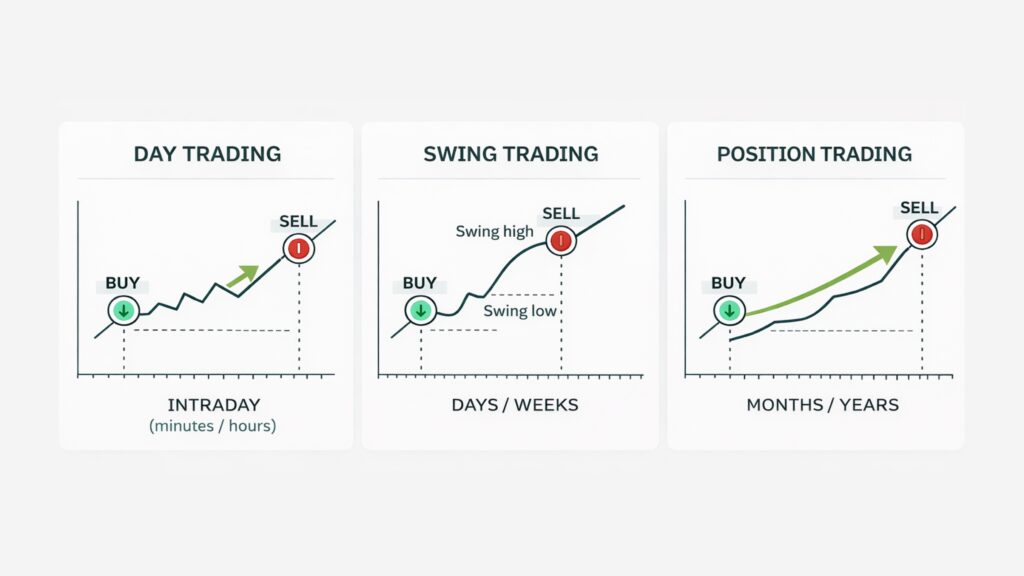
Choosing the right trading style is one of the most important decisions a trader can make. The debate around Day Trading vs Swing Trading vs Position Trading often comes down to time commitment, risk tolerance, capital size, and personal temperament. While all three strategies aim to profit from market movements, they differ significantly in timeframe, strategy, and lifestyle impact.
Understanding these differences can help traders align their approach with their financial goals and risk management preferences.
What is Day Trading?
Day trading involves opening and closing positions within the same trading day. Traders do not hold positions overnight, which eliminates exposure to after-hours market risk.
Day traders typically focus on:
- Short-term price movements
- Intraday volatility
- Technical analysis and chart patterns
- High trading frequency
Positions may last minutes or hours, but everything is closed before the market session ends.
Key Characteristics of Day Trading
- Requires constant screen time
- Relies heavily on technical indicators
- Demands quick decision-making
- Higher transaction frequency
- No overnight risk
Because of the fast-paced nature of day trading, it requires discipline, emotional control, and a well-defined risk management strategy. Small price fluctuations are the primary profit source, meaning precision and timing are critical.
However, day trading can also be stressful and time-intensive. It is often better suited for full-time traders who can dedicate hours each day to monitoring markets.
What is Swing Trading?
Swing trading falls between day trading and long-term investing. Swing traders typically hold positions for several days to several weeks, aiming to capture medium-term price “swings” within a broader trend.
Instead of focusing on minute-by-minute price action, swing traders analyze:
- Market trends
- Support and resistance levels
- Momentum indicators
- Chart patterns forming over multiple days
Key Characteristics of Swing Trading
- Positions held for days or weeks
- Less screen time required
- Combines technical and fundamental analysis
- Exposed to overnight market risk
Traders often find swing trading more flexible than day trading. Traders do not need to monitor markets continuously throughout the day. Instead, they can analyze charts during specific sessions and manage positions with predefined stop-loss and take-profit levels.
This strategy appeals to traders who want active participation but cannot commit to full-time market monitoring.
What is Position Trading?
Position trading is a longer-term strategy where trades are held for weeks, months, or even years. Position traders focus on major trends and macroeconomic factors rather than short-term fluctuations.
They typically analyze:
- Economic cycles
- Interest rate trends
- Corporate earnings
- Industry growth patterns
- Long-term chart structures
Key Characteristics of Position Trading
- Long holding periods
- Minimal daily monitoring
- Focus on macro trends
- Larger price targets
- Greater exposure to market cycles
Position trading resembles investing but remains strategy-driven. It requires patience and the ability to withstand short-term volatility while waiting for larger trend developments to play out.
Because trades are held longer, position traders must manage broader risk factors such as economic shifts and geopolitical events.
Day Trading vs Swing Trading vs Position Trading: Core Differences
When comparing Day Trading vs Swing Trading vs Position Trading, the primary distinction lies in time horizon and strategy intensity.
1. Time Commitment
- Day trading requires constant market monitoring.
- Swing trading demands periodic analysis.
- Position trading requires minimal daily oversight.
2. Trade Duration
- Day traders close positions within a single day.
- Swing traders hold trades for days or weeks.
- Position traders hold trades for extended periods.
3. Risk Exposure
- Day traders avoid overnight risk.
- Swing traders face moderate overnight exposure.
- Position traders experience long-term market cycle risk.
4. Profit Targets
- Day traders target small, frequent gains.
- Swing traders aim for medium price swings.
- Position traders pursue larger trend-based moves.
Each approach has advantages and challenges and the right strategy depends on a trader’s personality and available time.
Risk and Capital Considerations
Risk management plays an important role in all three strategies, but its application differs.
Day traders often use tight stop-loss levels because small market moves determine profitability. High leverage may be used, increasing both potential gains and risks.
Swing traders use wider stop-loss placements to accommodate short-term volatility. They aim to balance risk and reward over several trading sessions. Position traders typically use broader stop-loss strategies aligned with long-term trend structures. Because trades are held longer, position sizing and diversification become especially important.
Understanding your risk tolerance is essential when deciding between Day Trading vs Swing Trading vs Position Trading.
Which Strategy Is Right for You?
Choosing between Day Trading vs Swing Trading vs Position Trading depends on several personal factors:
1. Time Availability
If you can dedicate full trading hours daily, day trading may be suitable. If not, swing or position trading may be more practical.
2. Risk Tolerance
Short-term trading can involve rapid losses. Longer-term trading requires tolerance for broader price swings.
3. Financial Goals
Are you seeking short-term income, medium-term growth, or long-term capital appreciation?
4. Experience Level
New traders often find swing trading more manageable because it allows time for analysis and decision-making.
There is no universally “best” strategy. Successful traders often experiment with different styles before committing to one that aligns with their strengths.
Final Thoughts
The comparison of Day Trading vs Swing Trading vs Position Trading ultimately comes down to timeframe, commitment, and risk profile. Day trading focuses on short-term opportunities within a single session. Swing trading captures multi-day market moves. Position trading aims to benefit from long-term trends.
Each approach requires a structured strategy, disciplined risk management, and a clear understanding of market behaviour. Rather than asking which style is superior, traders should focus on which method best aligns with their schedule, financial objectives, and emotional tolerance.
By understanding the distinctions between these trading styles, market participants can make more informed decisions and develop a strategy that supports long-term consistency and growth.
Source: This article references publicly available materials including “Day Trading vs Swing Trading” published on stokestrades.com and “Position Trading vs Day Trading” published on tsginvest.com.
Disclaimer:
This article is for informational purposes only and should not be considered as financial or investment advice. The views and data presented are based on publicly available information and are subject to change without notice. Investing in financial markets involves risk, including the possible loss of capital. Past performance is not indicative of future results. Readers should do their own research or consult a qualified financial advisor before making any investment decisions. The author and publisher are not responsible for any losses arising from the use of this information. T&Cs apply. For full terms and conditions, please visit centrinocapital.com