
What is the Difference Between Trading and Investing?
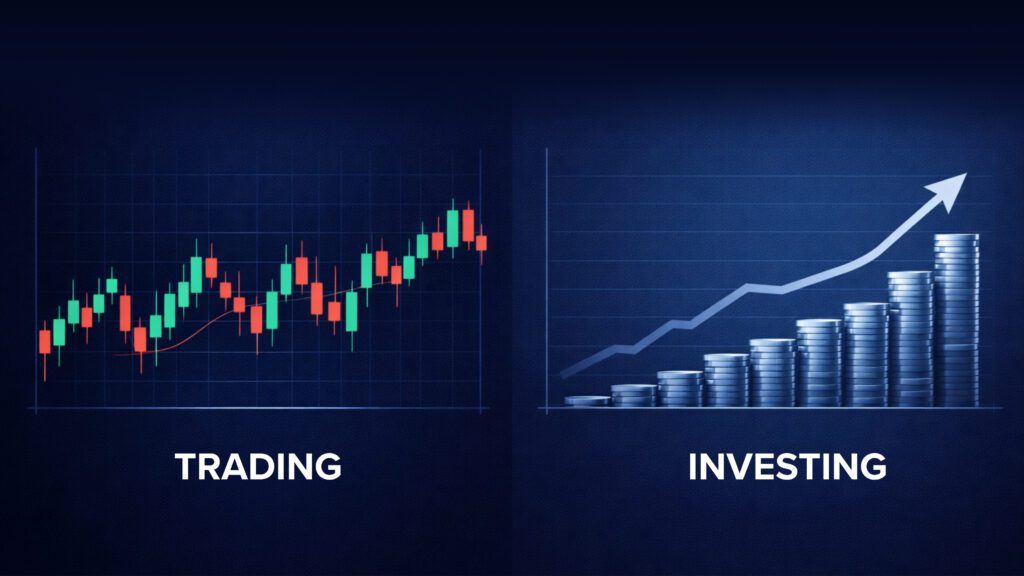
Trading and investing are two common approaches used in financial markets to generate returns. Although both involve buying and selling financial instruments such as stocks, they differ significantly in time horizon, strategy, and purpose.
Understanding the difference between trading and investing can help individuals choose the approach that best fits their financial goals, risk tolerance, and level of involvement in the markets.
What Is Investing?
Investing is generally defined as a long-term approach to building wealth. Investors typically purchase financial assets with the intention of holding them for years or even decades.
The primary goal of investing is long-term growth. Investors often focus on:
- A company’s fundamentals
- Long-term earnings potential
- Dividends and income generation
- Gradual capital appreciation
Rather than reacting to short-term price fluctuations, investors usually maintain their positions through market ups and downs. The expectation is that over time, markets tend to grow in value.
Investing involves a longer-term commitment to assets and is commonly associated with wealth accumulation over time.
What Is Trading?
Trading, in contrast, involves more frequent buying and selling of financial instruments. Traders aim to profit from short-term market movements rather than long-term growth.
The time horizon for trading is typically much shorter than investing. Positions may be held for:
- Minutes (day trading)
- Days
- Weeks
- A few months
Traders often attempt to take advantage of market volatility and price swings. Instead of focusing primarily on long-term fundamentals, trading may involve analyzing price patterns and market trends.
Trading involves more active participation in the market and typically requires closer monitoring of price movements.
Key Differences Between Trading and Investing
The main differences include:
1. Time Horizon
The most significant difference is time.
- Investing focuses on long-term growth over years or decades.
- Trading focuses on short-term price movements over days, weeks, or months.
Investors are generally less concerned with daily fluctuations, while traders actively seek to capitalize on them.
2. Strategy and Approach
Investors typically evaluate companies based on fundamentals such as financial health, growth prospects, and overall business performance.
Traders, on the other hand, are more focused on price action and short-term market behavior. Their goal is to enter and exit positions at favorable price levels.
3. Frequency of Transactions
Investing usually involves fewer transactions. Investors typically purchase assets with the intention of keeping them for the long term.
Trading involves frequent transactions, as traders continuously look for opportunities to enter and exit the market.
4. Risk Exposure
Trading can involve higher short-term risk because it depends on accurately predicting price movements over brief periods. Market volatility can have a larger immediate impact on traders.
Investing is generally considered a longer-term strategy that may smooth out short-term volatility over-time. However, both trading and investing involve risk.
5. Time Commitment
Investing is often more passive in nature. Investors may periodically review their portfolios but do not typically monitor markets constantly.
Trading requires more active involvement. Traders usually spend more time analyzing markets and tracking price changes.
Which Approach Is Better?
Investopedia does not suggest that one approach is universally better than the other. Deciding whether to trade or invest ultimately comes down to:
- Financial goals
- Risk tolerance
- Time availability
- Market knowledge
Some individuals prefer the long-term focus of investing, while others are drawn to the active nature of trading. Both strategies can be used in financial markets, but they require different mindsets and levels of engagement.
Conclusion
While trading and investing both involve participating in financial markets, they are not the same.
Investing is a long-term strategy focused on building wealth gradually through holding assets over extended periods. Trading is a short-term approach that aims to generate profits from market fluctuations.
The key differences lie in time horizon, strategy, frequency of transactions, and level of involvement. Understanding these distinctions can help individuals make informed decisions about how they want to approach the financial markets.
Source: This article references publicly available material including “Difference Between Investing and Trading” published on investopedia.com.
Disclaimer:
This article is for informational purposes only and should not be considered as financial or investment advice. The views and data presented are based on publicly available information and are subject to change without notice. Investing in financial markets involves risk, including the possible loss of capital. Past performance is not indicative of future results. Readers should do their own research or consult a qualified financial advisor before making any investment decisions. The author and publisher are not responsible for any losses arising from the use of this information. T&Cs apply. For full terms and conditions, please visit centrinocapital.com